
24th Mar, 2024
Everest base camp trek from Lukla to Lukla
Embark on a poetic adventure through the heart of the Himalayas with the Everest Base Camp Trek. From the bustling gateway of Lukla to the serene, snow-clad heights of Everest Base Camp, experience the grandeur of towering peaks, ancient monasteries, and the timeless beauty of the Khumbu region. Each step unveils a new chapter in this epic journey, where the mountains whisper their secrets and the spirit of adventure comes alive
Table of Contents
Everest Base Camp Trek: A Journey from Lukla to Lukla
The moment you step off the plane in Lukla, the mountains greet you like ancient sentinels, their snow-clad peaks piercing the heavens with a quiet majesty. The cool, crisp air is thick with the promise of adventure, and each breath fills your lungs with a sense of the unknown. The hum of life in Lukla is vibrant, where trekkers from across the globe gather, exchanging nervous smiles, all drawn here by a singular dream: to stand beneath the towering shadow of Everest herself.
The trail unfurls before you, leading into the heart of the Khumbu region, where civilization whispers at the edges of nature's wildest expanses. As your boots meet the stony path, the rhythmic crunch of gravel beneath your feet becomes a meditative mantra. Each step carries you deeper into this world of rugged grandeur, where time seems to slow, and every moment stretches, suspended between earth and sky.
The first leg of the journey takes you through lush rhododendron forests, their blossoms painting the landscape in bursts of crimson and pink. The Dudh Koshi River murmurs beside you, its waters a frothy turquoise, racing with a determination that mirrors your own. Bridges sway above the churning current, suspended by thick ropes that groan beneath the weight of your passage. Each crossing feels like a rite of passage, a test of your resolve.
As you ascend towards Phakding, the trail begins to reveal the heart of Sherpa culture. Stone houses, their roofs heavy with slate, dot the hillsides, and prayer flags flutter in the breeze like the colorful sighs of the mountains. Mani stones, etched with ancient prayers, line the path, and you pause to spin a prayer wheel, hoping the whispered mantra will carry your aspirations to the lofty realms above.
Namche Bazaar, the gateway to Everest, rises before you like a bustling amphitheater carved into the mountainside. Here, the world shrinks and expands all at once—where yaks wander freely, and traders hawk their wares with the melodic tones of Tibetan song. Namche is a place of contrasts: where modernity touches the ancient, and the hum of Wi-Fi mingles with the echo of centuries-old prayers. The air is thinner here, each breath harder won, but it sharpens your senses, heightening your awareness of the vastness that surrounds you.
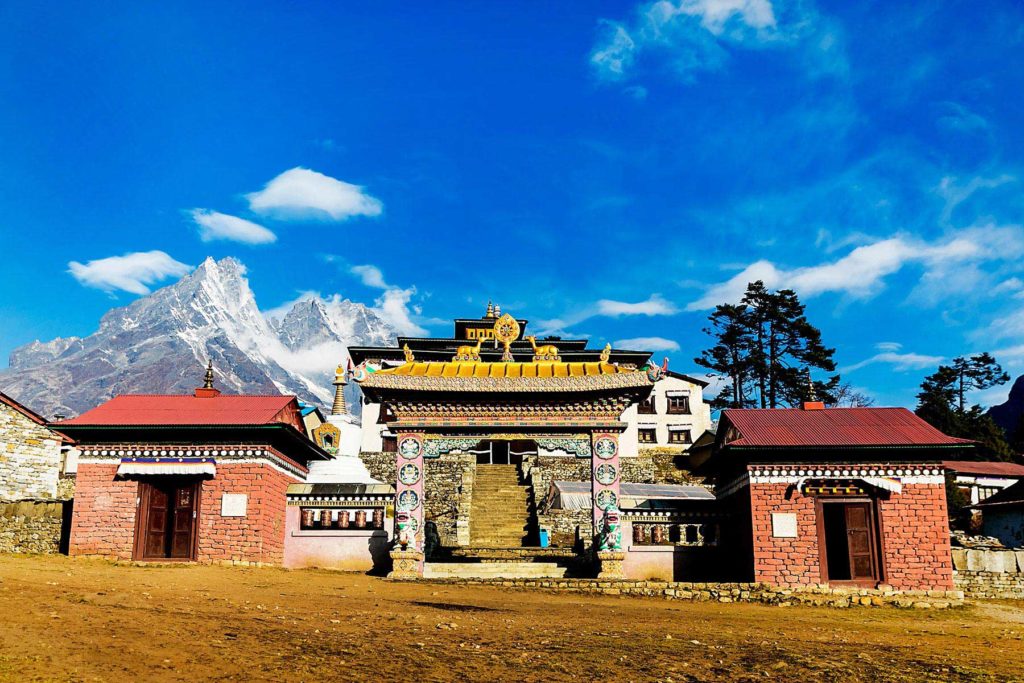
The trek from Namche to Tengboche is a journey through time, where each step takes you deeper into the heart of this sacred land. As the trail climbs higher, the trees thin, giving way to alpine meadows, where the earth seems to meet the sky. Tengboche Monastery emerges like a dream, its golden spire gleaming against the backdrop of Everest and her sisters. The monks here chant their prayers, the sound echoing in the cold, thin air, as if calling to the mountains themselves.
Beyond Tengboche, the landscape grows more austere, more elemental. The air is thinner now, and every step feels heavier, each breath a conscious effort. But the beauty of the Khumbu reveals itself in this starkness—the way the mountains catch the light at dawn, their faces glowing in hues of rose and gold, or the way the snow crunches beneath your feet in the stillness of early morning. It is a land where silence speaks volumes, where the wind carries the wisdom of millennia.
Dingboche is a windswept village, nestled in a valley that feels both exposed and protected. Here, the mountains loom closer, as if reaching down to cradle the tiny settlement in their shadow. The nights are cold, and the stars burn brightly in the ink-black sky, close enough to touch. The weight of the world seems to fall away here, leaving only the vast, unknowable silence of the Himalayas.
As you continue towards Lobuche, the trail becomes a testament to the tenacity of life in this harsh, unforgiving environment. The cairns marking the way to the Khumbu Glacier serve as a reminder of those who have ventured before you, some never to return. Yet, even in this desolate place, the spirit of the mountains lifts you, urging you forward.
Gorak Shep, the last stop before Everest Base Camp, feels like the edge of the world. The wind howls through the barren landscape, and the looming presence of Everest dominates the horizon. Here, the mountains are no longer distant sentinels—they are companions, guiding you, watching over you. Every muscle aches, and the altitude presses down like an invisible hand, but the pull of the mountain is undeniable.
Finally, you stand at Everest Base Camp, a place where dreams and reality collide. The Khumbu Icefall stretches out before you like a frozen river, its jagged crevasses a reminder of the peril and beauty intertwined in the world’s highest places. Everest herself remains aloof, her summit often shrouded in cloud, as if she is reluctant to reveal her secrets. Yet, being here, at her feet, is enough. You are part of something far greater than yourself—part of the legacy of those who have walked this path, and of those who will come after.
The journey back to Lukla feels different, as though the mountains have shared some of their ancient wisdom with you. The trail is the same, yet you see it with new eyes. The flowers seem brighter, the rivers louder, the faces of the Sherpa warmer. As you descend through the valleys, the weight of the altitude lifts, and with it, the burdens of the everyday world.
Lukla comes into view once more, and with it, the end of the trek. The mountains, ever-watchful, stand as they always have, silent and eternal. Yet, you know that a part of you will remain here, woven into the fabric of the Khumbu, carried on the wind, and etched into the stone paths of the Everest Base Camp trek.
Everest base camp trek from Lukla to Lukla
The journey from Lukla to Everest Base Camp is a love letter to the mountains, a whispered romance between earth and sky. As you step from the plane, the cool mountain air greets you like a long-lost lover, crisp and full of promises. The trail unfurls before you, winding through ancient Sherpa villages, where the hum of prayer wheels and flutter of colorful flags sing of devotion.
Each footfall feels like a heartbeat, growing stronger as you climb higher, through forests kissed by rhododendron blooms, across swaying bridges suspended over turquoise rivers. At night, the stars burn like embers, watching over you as you dream beneath the Himalayas' embrace.
As you reach Base Camp, the world falls away, leaving only the raw pulse of the earth. Everest, towering and untouchable, feels like a lover out of reach, yet so close you can feel its breath on your skin.
Day 1: Lukla (2,860m) to Phakding (2,610m)
The adventure begins the moment your feet touch the ground at Lukla, the gateway to Everest. The small plane has barely landed before you’re engulfed in the crisp mountain air, the scent of pine, and the faint smell of yak butter tea wafting from nearby teahouses. Surrounded by jagged peaks and cloud-covered horizons, Lukla hums with the energy of adventurers starting or finishing their journeys. Setting off, the path meanders through lush green hills, crossing crystal-clear streams, and traversing suspension bridges that sway beneath your feet. The trail gently descends to Phakding, a small village nestled along the Dudh Koshi River. The walk feels effortless today, the altitude light, with the promise of Everest hidden behind the distant ridges.
Day 2: Phakding (2,610m) to Namche Bazaar (3,440m)
The morning sun filters through the rhododendron trees, casting dappled light across the trail as you push onward. The Dudh Koshi River rushes beside you, its turquoise waters tumbling through the narrow valley. The path leads through scattered villages, over swinging suspension bridges, and past mani stones etched with prayers, worn smooth by the hands of generations. The day’s climb intensifies as you approach Namche Bazaar, the bustling Sherpa capital. As the altitude increases, so does the challenge, the air thinner with each step. But Namche, perched dramatically on the hillside, welcomes you with its lively market, warm teahouses, and spectacular views of the distant snow-clad peaks. It’s a place where adventure collides with culture, and the world feels both vast and intimate.
Day 3: Acclimatization Day in Namche Bazaar (3,440m)
Today is a day of rest, but not idleness. Namche Bazaar, with its colorful stone buildings and panoramic views of Everest and Ama Dablam, serves as both a waypoint and a respite. To acclimatize, you ascend the ridge above Namche, climbing to the Everest View Hotel at 3,880 meters. From this vantage point, the Himalayas unfold before you in all their glory, each peak more awe-inspiring than the last. The sight of Everest, so distant yet so near, fills you with a quiet reverence. The rest of the day is spent exploring Namche's narrow, winding streets, visiting monasteries, and marveling at the spirit of this mountain town.
Day 4: Namche Bazaar (3,440m) to Tengboche (3,860m)
Leaving Namche behind, the trail leads upwards, but the mountains now feel closer, more intimate, as though drawing you into their folds. Everest’s summit peeks out intermittently, framed by the rugged spires of Lhotse and Nuptse. The walk to Tengboche is a journey through the heart of Sherpa land. The path undulates through forested trails, where juniper and pine trees stand tall, their branches heavy with prayer flags. The final climb to Tengboche is steep but rewards you with one of the most iconic sights on the trek: Tengboche Monastery, set against the towering backdrop of Ama Dablam. At 3,860 meters, the air feels thinner, the cold more biting, but the spiritual aura of the monastery, the soft chants of monks, and the vibrant fluttering of prayer flags fill you with warmth.
Day 5: Tengboche (3,860m) to Dingboche (4,410m)
Today, the landscape shifts dramatically. The forest recedes, giving way to alpine meadows and rocky paths. The sky feels wider, the mountains taller, their snow-covered flanks gleaming under the midday sun. The climb grows more demanding, and each breath becomes harder to catch as you push beyond 4,000 meters. Dingboche, perched at 4,410 meters, lies in a broad valley beneath the looming mass of Ama Dablam. The village is quiet, windswept, and surrounded by fields of barley, their golden hues a striking contrast against the icy giants overhead. Here, life feels simple, almost otherworldly, where time is measured by the movement of the sun across the peaks.
Day 6: Acclimatization Day in Dingboche (4,410m)
Acclimatization is essential at this altitude, where the air is thin, and every movement feels heavier. You embark on a short hike up the hills surrounding Dingboche, climbing to 4,700 meters, where the panoramic views of Lhotse, Makalu, and the distant Cho Oyu leave you breathless, not just from the altitude but from their raw, untamed beauty. The day is spent wandering through the barren landscape, where hardy shrubs cling to life, and the mountains seem to speak in the howling winds. Dingboche at night is silent, save for the distant rumble of glaciers shifting in the cold.
Day 7: Dingboche (4,410m) to Lobuche (4,940m)
The journey continues towards the glacial moraine of the Khumbu Glacier. The terrain becomes starker, the altitude more punishing. Each step feels deliberate, the weight of the thin air pressing down as you approach Lobuche at nearly 5,000 meters. Cairns and memorials to fallen climbers dot the landscape, silent tributes to the fragility of life in the mountains. The atmosphere is solemn yet awe-inspiring. Lobuche is a small, rugged settlement surrounded by towering peaks, where the biting cold and altitude demand respect. You are now in the shadow of the greatest mountains on Earth.
Day 8: Lobuche (4,940m) to Gorak Shep (5,170m) and Everest Base Camp (5,364m)
This is the day you’ve dreamed of. The trail from Lobuche to Gorak Shep feels like the edge of the world—barren, cold, and starkly beautiful. The altitude is unforgiving, each breath a struggle, but your determination propels you forward. Gorak Shep is the last stop, a frozen outpost beneath the towering presence of Everest. From here, you make the final push to Everest Base Camp. The path winds over the glacial moraine, past ice formations and boulders, until at last, the fabled camp comes into view. At 5,364 meters, you stand in the shadow of Everest, where dreams meet reality. The summit may be hidden, but the sense of accomplishment is tangible, a memory etched into the very fabric of your being.
Day 9: Gorak Shep (5,170m) to Kala Patthar (5,545m) and Pheriche (4,371m)
Before dawn, you climb Kala Patthar, a small peak at 5,545 meters, to witness the sunrise over Everest. The cold bites at your skin, the thin air burns your lungs, but as the first rays of light touch Everest’s summit, the world stands still. This is the pinnacle of your journey—the closest you’ll come to the roof of the world. The descent to Pheriche feels like returning from another planet, the weight of the altitude easing with every step.
Day 10-12: Return to Lukla (2,860m)
The return journey retraces your steps, but with a sense of completion. The mountains, once towering and imposing, now feel like familiar friends. As you descend through the valleys, crossing back through Namche Bazaar, Phakding, and finally Lukla, the air thickens, and the colors of the landscape become more vibrant. Each step is lighter, each breath fuller. The journey, though complete, lingers in your soul. The mountains have left their mark, and as you arrive in Lukla once more, you know a part of you will always remain in the shadow of Everest.
How to Reach Everest base camp trek from Nepal ?
To reach the fabled Everest Base Camp, your journey begins in Kathmandu, Nepal’s bustling capital, where ancient temples and modern streets hum with energy. From here, a short, heart-racing flight transports you to the mountain town of Lukla, perched precariously at 2,860 meters, with its tiny airstrip nestled between green cliffs and towering peaks.
Lukla marks the trailhead of your adventure. As you step onto the path, the air grows crisper, and the world begins to narrow into a tapestry of fluttering prayer flags, rushing rivers, and suspended bridges swaying above deep gorges. You’ll pass through Sherpa villages like Namche Bazaar, a vibrant haven of yaks and prayer wheels, where altitude begins to whisper in your lungs. The trek winds higher through the rhododendron forests and into the stark wilderness of alpine meadows, glaciers, and moraine.
Step by step, day by day, you rise towards the frozen throne of the Himalayas. At 5,364 meters, Everest Base Camp stands not as a destination but a testament to your spirit, offering a close communion with the legendary peak itself, the roof of the world.
The journey to Everest Base Camp begins in Kathmandu, a city cradled between the ancient and the eternal. Here, amid the prayer flags fluttering like secret wishes, your adventure begins with a flight that feels like a lover’s leap into the arms of the Himalayas.
The small plane whisks you away to Lukla, where the mountains stand like sentinels, waiting. From Lukla, the path ahead is a slow waltz with nature, each step drawing you closer to Everest’s embrace. The trail winds through Sherpa villages adorned with prayer wheels spinning in the wind’s soft caress. The air, cool and crisp, grows thinner, and your heart races not just from the altitude but from the sheer beauty that surrounds you.
Each day on the trail brings you deeper into the soul of the Himalayas until, at Everest Base Camp, you stand humbled, heart wide open beneath the gaze of the world’s highest peak.
Recent From Blog


8th Sep, 2026

16th Aug, 2026

10th Aug, 2026

8th Aug, 2026

1st Aug, 2026

31st Jul, 2026

29th Jul, 2026
25th Jul, 2026

29th Jun, 2026
4th Jan, 2026


5th Jun, 2025

19th May, 2025

9th May, 2025

18th Apr, 2025

22nd Oct, 2024
21st Oct, 2024
19th Oct, 2024

18th Oct, 2024

11th Oct, 2024
11th Oct, 2024
8th Oct, 2024
